
Con: Murder is wrong
The deliberate, unlawful taking of a human life can never be reconciled with ethical reasoning.

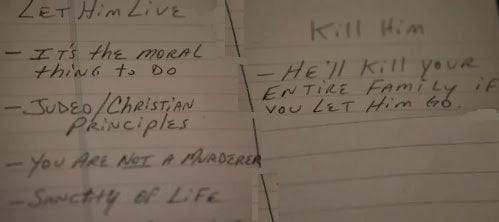
Here’s how the American author Jonah Goldberg described a pivotal scene in the show Breaking Bad,
which is about a high school chemistry teacher, Walter White, who descends into the criminal underworld after being diagnosed with terminal cancer.
In the first season, Walter is confronted with the necessity — or “necessity” — of killing another human being. He has trapped a drug dealer in the basement of his partner, a former student of his who has turned into a lowlife meth-head, Jesse Pinkman. Despite establishing a rapport with the dealer, who goes by the handle “Krazy 8,” Walter agonizes over what to do with him.
Still the man of reason, he sits down with a notepad and writes up a list of pros and cons. Among the items on the list: “Con: MURDER IS WRONG! Pro: He’ll kill your entire family if you let him go.”
Walter ultimately kills Krazy 8, but under circumstances that he can justify as self-defense. Over time, though, Walter’s definition of self-defense grows beyond any moral justification, and his reluctance to kill shrinks to almost nothing. Once you step outside the borders of morality and the law, self-interest becomes self-justifying.
Murder, the intentional and unjust taking of human life, is a grave transgression of the highest order. To commit a murder is to deny the intrinsic dignity and worth of other human beings. This is true regardless of who the victim is, including a CEO whose business practices may cause harm, even serious harm, to his customers.
Even in the face of widespread anger or frustration, the deliberate killing of another human being is an abhorrent act that crosses an unthinkable ethical line.
All societies, in all times and places, have prohibited murder. This universal proscription is one of the most powerful rebukes to arguments for moral relativism. At some basic level, he sanctity of human life is a shared principle across cultures, ideologies and legal systems. Even those who differ on many moral and cultural issues stand united in condemning the deliberate taking of another’s life, unsanctioned by legitimate authority, is to invite chaos and barbarism.
In the case of murder victim Brian Thompson, much rationalisation has occurred on the bass of his company’s record of claims denials having had devastating consequences for people who deserved better cover. But directness and intention matter. An unjust insurance system, as reprehensible as it may be, operates within a framework where harm is:
Indirect, in the sense of not being desired or deliberately sought after; and
Systemic, with no single person - not even the boss - being fully responsible.
Deaths that result from denied claims or inadequate coverage, while devastating, are not the direct or intended outcome of the Thompson’s actions. His murder, by contrast, was a direct and intentional act for which only one person - the murderer - was responsible.
To equate these two or to suggest that corporate malfeasance somehow justifies taking a life is not merely a moral misstep but a contemptible and grotesque category error.
Even more contemptible are those who attempt to blame Thompson for their own murder, claiming it to be understandable because of his role in a flawed system. This not only undermines justice but also indulges a cowardly instinct to scapegoat individuals for systemic problems. Those who permit such reasoning, let alone celebrate it, have abandoned any legitimate claim to morality or the rule of law.
To be completely clear, murder is not wrong because it is illegal. It is illegal because it is wrong. It is an affront to human equality, asserting that one person’s life is worth less than the frustrations or grievances of another.
This kind of moral calculation, where someone’s perceived guilt or unpopularity is used to explain or minimise their killing, is not just dehumanising—it is a profound threat to the trust and mutual respect that holds people together.
Human justice systems are imperfect, but they exist to ensure that grievances are resolved without descending into private violence and vendetta. To kill someone out of anger or frustration with systemic harm is to embrace chaos instead of order. It is the ultimate hypocrisy: claiming to fight injustice through an act that epitomises it.
Breaking Bad is a good moral litmus test for viewers, challenging them to grapple with Walter White’s descent into violence and depravity. It’s always revealing to see who, after watching the show, believes White was somehow justified because he was protecting his family in a system that had failed him.
While his plight invites sympathy, his choices are a glaring failure of moral fortitude. It’s eye-opening, even unsettling, to hear people continue to sympathise with White, excusing his actions as necessary or inevitable, revealing how deeply lacking in moral fiber some individuals can be.
But that is fiction, crafted to provoke and explore moral ambiguity in the safety of the hypothetical. To see people in real life cheering on the murder of Brian Thompson, a human being killed in cold blood, is more than unsettling. It has been sickening.
Finally, let us be unequivocal: murder is not mitigated by outrage or frustration, no matter how legitimate those emotions may feel. The deliberate, unlawful taking of a human life can never be reconciled with ethical reasoning. I don’t care about what is says if lots of people have been whipped up into a sense of righteous indignation.
The sanctity of human life is not subject to popular opinion and the fleeting sentiment of the digital mob.
In my opinion, you are carefully tap-dancing around the definition of murder with the unlawful part. Look at the list of NZs VC winners. They killed (murdered) a lot. Were they all justified or were there one or two victims who were a more innocent?. I had a family member who was a Corsair pilot and killed dozens of Japanese, probably not ALL justified. Another was an infantryman, who stated "after we saw what the little yellow b......s did, WE NEVER TOOK prisoners. How does that fit? And the "lawful" bit can be rather flexible and morally dubious. Many resistance members in WW2 were murdered by the Nazis, SS, et al in accordance with German law at the time. Post War, it was good to see about 800 of the worst offenders (who mainly argued they acted lawfully), were strung up.
While it was murder in the United Healthcare case, I feel no sympathy for him. Sadly it will change little, except that healthcare premiums will rise as they will now expend many millions on personal security for executives, staff, buildings and facilites.
Spot on. And the same goes for all those who stood up and applauded in the NZ Parliament when the abortion legalisation Bill was passed, allowing the murder of unborn children and the manslaughter of children who are born (i.e., those children born alive and are simply left to die). The depth of their depravity was shocking.