

Form Guide: August
What’s the actual state of the race for the 2026 election?

Christopher Luxon’s political survival this week may not be entirely down to a favourable Curia poll released the previous Friday, but it couldn’t have hurt. National led the pack at 31 pc, just over three points ahead of Labour. Together with ACT and NZ First, the seat projection showed a slender government majority.
Then the chaos that everyone is by now thoroughly sick of talking about. The dust on that barely starts to settle, and the Herald reports on a new survey from Talbot Mills showing National down to 29 pc, with Labour on 34 pc. According to this poll, there is no way the government is returning to power unless it makes a deal with the Opportunity Party, whose leader [and Luxon] has ruled out working with them.
But here’s the thing not really highlighted in the narrative the Talbot Mills poll was used to help build: its survey period overlapped with the Curia poll. For that poll, responses were gathered from the first day of August through the fourth. The Talbot Mills poll was more extended, starting on the first and ending on the eleventh. The fact that they were published a week apart obscures the fact that somebody who answered the one poll on the third could have answered the other on the same day.
So the inevitable framing that the two surveys show some kind of sequence in a story about a week in politics isn’t really right. It’s really a story about how two polling companies got different results from similar samples of the population over a similar period. And as far as stories go, it’s very much in the dog bites man category, because that’s something that happens with polls more often than not.
Stringing together different polls like this is an easy, if lazy, way to build up hype and the illusion of volatility. For example, the framing around the Talbot Mills poll was expressly that Chris Hipkins had “overtaken” Christopher Luxon as preferred prime minister.
The problem is that Chris Hipkins has led Christopher Luxon in every single Talbot Mills poll of the last year or so
So in what sense had Hipkins “overtaken” Luxon? Other than on an apples and oranges comparison of two different surveys, each with their own weighting methods, contact modes and historical leans? Only in the narrative-building sense.
The corrective to this error is not complicated. If you want to work out what’s happening, look at trends within the same series instead of across them. If Talbot Mills, Curia, Roy Morgan and Verian have different numbers that each tell the same basic story, things begin to look a lot less chaotic.
So with that in mind, what is the state of the race? Well, let’s look at four of the main series grouped by the coalition parties, the opposition parties and TOP, which for present purposes we will treat as an independent faction.
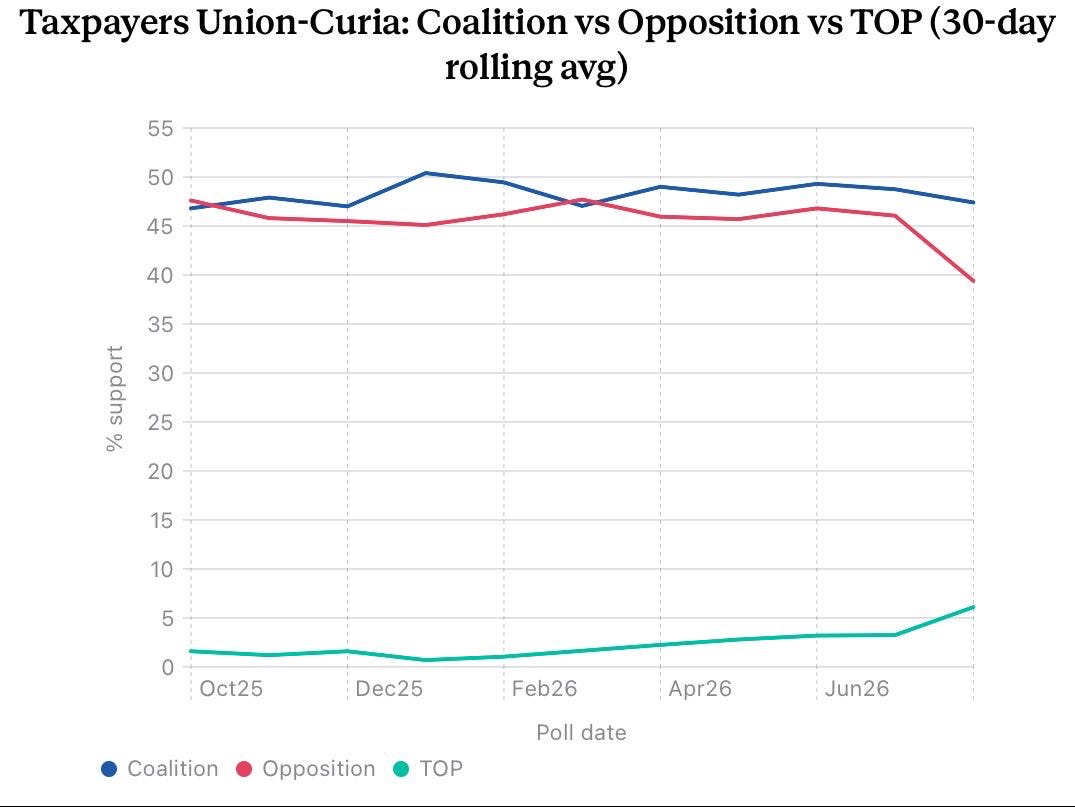
For Curia:
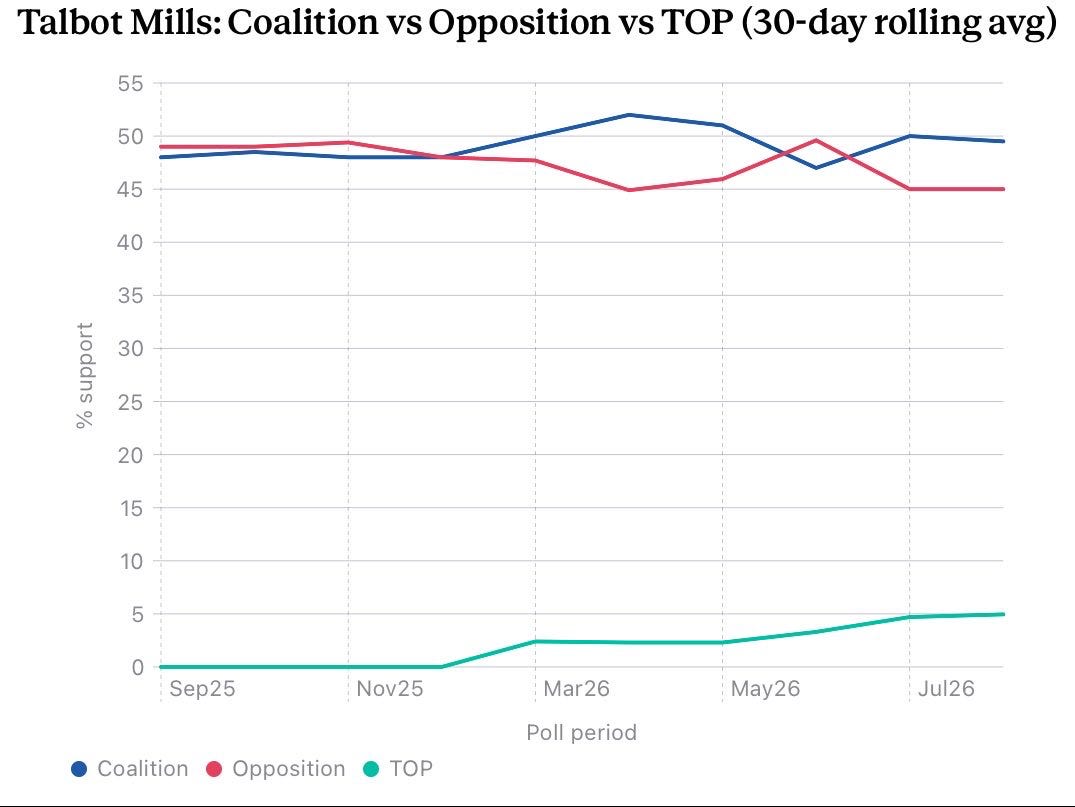
For Talbot Mills:
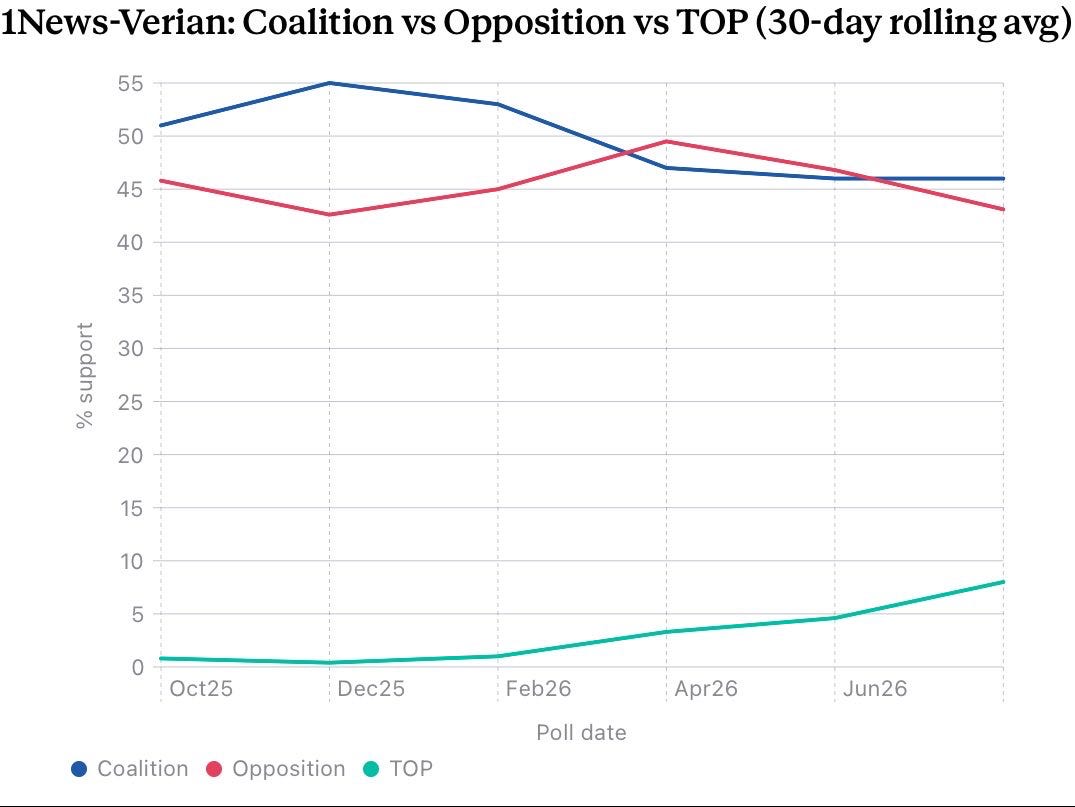
For Verian:
For Roy Morgan:
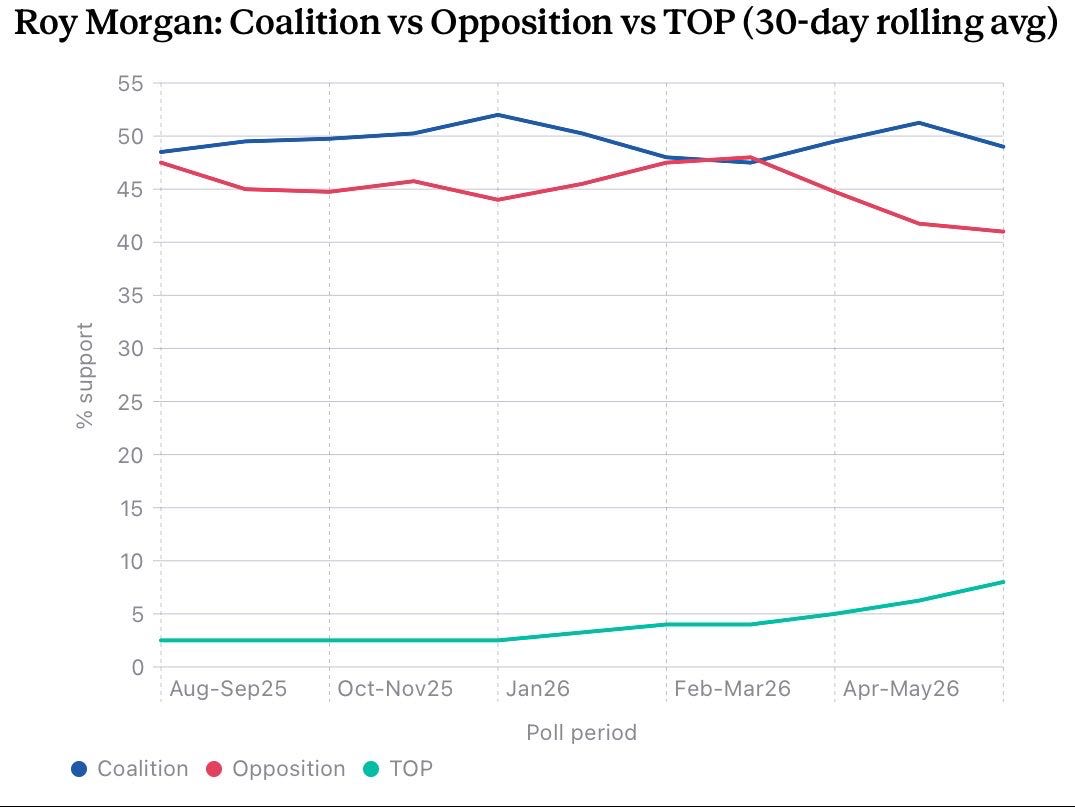
As I say, there’s a lot of variance as to the precise numbers, but the story they tell is generally pretty similar. And that goes as follows:
Support for the Parliamentary opposition peaked at some point in the first part of the year and has been trending down since. Most of this decline has come from steadily eroding support for the Labour Party.
While National has often trailed Labour, the governing bloc has held up due to the unusual strength of NZ First and ACT as junior coalition partners. But the decline in support for the opposition hasn’t boosted them, because of a third trend.
There is an unambiguous momentum behind the Opportunity Party, which has enjoyed a genuine and sustained surge in support.
So less than three months from an election, the state of the race is as follows:
The 2026 election result looks to be very competitive and extremely close. The government and opposition blocs have spent a year trading narrow leads and headed into the last stretch, neither has a conclusive advantage over the other.Everything may hinge on TOP.
If it clears the threshold, it will have real leverage and the ability to determine who the government is. Christopher Luxon has already ruled out working with the party after the election, but if it’s a choice between revising that view and political oblivion, expect some world class bush lawyering about what “working with” means.
If TOP falls short, however, you would have to say the numbers as they stand favour the coalition, however tentatively.
In that case, the big wildcard there would be how many seats TPM win and whether that produces an overhang. A sweep of the Māori electorates like 2023 would give the opposition a cushion against any party vote shortfall.
But given how volatile those seats have been this century, you’d have to be very brave to predict any particular outcome on this front, especially given the strong quality of many of the candidates Labour is fielding in the Māori seats.
Or, in three and a half words: it’s anyone’s game.
The Opportunity Party proposal to impose a 1.75% annual tax on urban land values and 0.5% on rural land to curb speculation and lower house prices was questioned by Jack Tame on @Q&A this AM. Hard to see OP getting above 5% with that policy
Well done.
Left unsaid is the fact that 3 of the latest 4 polls shoe NZ First rapidly declining since April.
Every time Peters and Jones obloviate with their buffoonery the voters run for the hills and give their support to either ACT or National.
Keep it up Peters and Jones , you are destroying NZ First from within.