
Opportunity Knocks
The Media Can Give You the Push. It Cannot Get You Over.

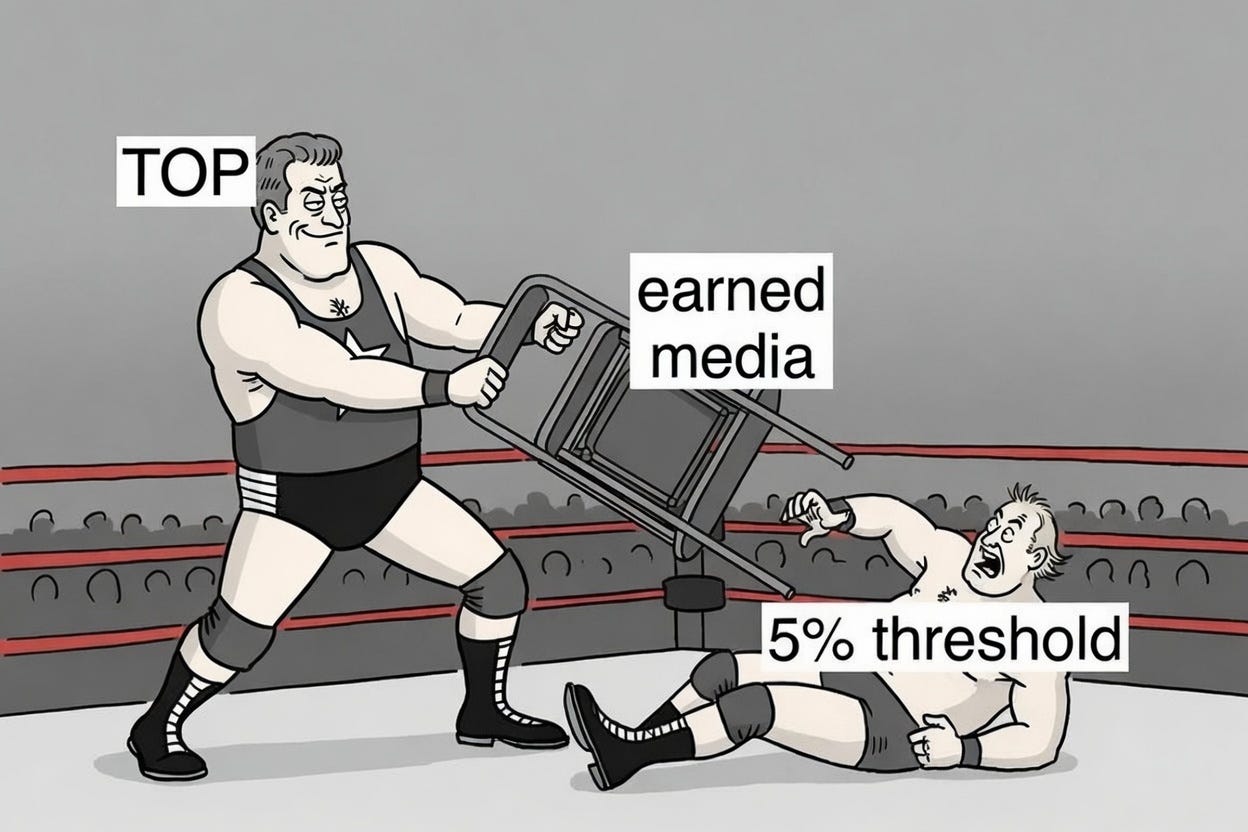
It’s almost a cliche now, but it’s true that much can be learned about politics by the careful study of the conventions and practices of professional wrestling. There are those who would prefer their analogies to come from Thucydides or, at a pinch, the game of cricket. But for our age, at least, nothing quite explains how politics works like the WWE.
I don’t mean this in the same way as a cynic will say that modern politics is “just like wrestling,” to suggest that it is all fake. That is wrong twice over. Professional wrestling is no more fake than ballet is. Both depend on performers doing genuinely difficult and dangerous things and both ask the audience to suspend disbelief in service of a narrative.
It is true that in politics the outcomes are less predetermined. Everything depends on who wins enough votes. But political messaging and campaigning, like wrestling, is very often contrived. Spontaneous moments are rehearsed and unscripted gaffes are, more often than you might think, calculated risks.
Once you stop asking “is this real?” and start asking “who arranged this, and what response do they want?”, you are on the path to becoming the political equivalent of a smark. In wrestling parlance, that means a fan who follows both the storylines in the ring and the machinery behind them.
And this brings us to another wrestling jargon term: the push.
A push is what happens when a wrestling promotion decides a particular wrestler has the potential to sell a lot of t-shirts. So they become favoured. They get the good storylines, main event bookings and interviews meant to make them look good. Their victories feel consequential and their defeats are scripted to be noble and heartbreaking.
What we have watched happen to the Opportunity Party over the last few months is a push.
I do not mean to sound overly conspiratorial here. But look at the coverage, to pick just a few things at random:
a warm profile with Mava Moayyed at 1News over a matcha latte; and
a long premium piece from the Herald’s Derek Cheng.
That’s just a smattering. It was quite noticeable that a party that has never cleared the threshold, led by someone who has never been an MP, started attracting earned media wildly out of proportion to its size. The press, without coordinating, decided Qiulee Wong was a story culminating in a cascade of “surprise surge” stories the moment a Verian poll put them at 4.6 percent.
But here is the part the cynics miss: a push guarantees nothing. The promotion can pour every resource it has behind a wrestler, and if the audience does not respond, the audience does not respond. A push is an act of grace that has no value if the recipient does not cooperate by responding with charisma, credibility and something the consumers actually want.
The history of wrestling is a graveyard of failed pushes, even when the talent was often real.
Lex Luger had the physique, the look, and a company desperate to make him an All-American hero. He was handpicked by owner Vince McMahon to be the successor to Hulk Hogan himself.
But the crowd never bought him as the top man. Before his big push, he had performed as an arrogant heel. All of a sudden he was being repackaged as a flag-waving American hero and it just didn’t make sense. And while there was nothing wrong with his performances per se, Luger just lacked the natural connection that Hogan (and later Bret Hart) found so easily.
McMahon also spent two years and, by one account, “moved heaven and earth” to install Roman Reigns as the face of his company, and was rewarded with booing so loud the producers reportedly piped in fake cheers to cover it. The fans, in the end, choose. You cannot make them care, and they resent being told they should.
The Opportunity Party knows this terrain, because it has been pushed before. Gareth Morgan founded it on a wave of coverage. Each time the media decided there was a story and each time the public declined to ratify it. For the most part, the party stayed marooned in its one-to-two-percent rut.
What is different now, if the poll is to be believed, and a single poll is a thin reed, is that a larger audience may finally be more receptive. The push may be real, but the response is probably more organic than the cynics will allow.
The press can no more conjure enthusiasm from nothing than a wrestling promotion can. Both can put a performer in front of audiences, but neither can compel a favourable response. Every failed push has involved a media machine pulling the levers it had and an audience that folded its arms.
If voters were genuinely uninterested in a supposedly centrist, blue-green alternative to the existing blocs, no amount of friendly profiles would move the numbers. And the party’s own earlier, equally well-covered relaunches prove this since none of them led to any kind of take-off.
I should nail my own colours to the mast here. I would never vote for TOP. Its technocratic, clever-person-at-a-whiteboard politics cuts contrary to everything I believe in. I do not want a politics run by people who think society is just waiting to be optimised by the right policy dashboard. The whole anthropology of the party is the antithesis of what I think politics is and should be about.
A UBI would be spiritually disastrous because work is not just a way of allocating money, but one of the ordinary disciplines that attaches people to duty, competence, service and reality. The idea that if necessity is softened people will naturally become creative, civic-minded and fulfilled, rather than often drifting into dependency and uselessness, cuts hard against human nature. And a land value tax offends me because it treats the most settled, intergenerational form of property as a convenient hostage, forcing families to keep paying tribute on property they may have spent several lifetimes building or preserving.
But this is not about that. If the polls are real, the honest conclusion is an uncomfortable one for the party’s critics. The coverage was necessary but not sufficient. Something in the offering is connecting a bit better than it was before.
That’s probably partly down to war of attrition we are seeing between the relatively stable partisan blocs of our existing Parliament. But also, to be fair, TOP is beginning to act more like a normal political party. It seems more disciplined, less performatively disruptive and more interested in looking a bit more conventional and a bit less performatively disruptive and performatively disruptive.
In wrestling terms, TOP has stopped working the undercard as a novelty gimmick chasing cheap pops and started trying to get over as a serious babyface at the top of the card, the sort of act the bookers might plausibly heat up for a main-event run.
But the crowd has got to buy it. Or at least 5% of them do.
When push comes to shove surely voters will read TOP policies. Otherwise we will be a nation of supplication beneficiaries on parliaments teat and house sellers unable to pay land taxes.
Q is a smiling Communist .