
Smith v Fonterra, explained
And the action the government should take to save the courts from themselves

You have probably all heard something about the Government legislating to “take away people’s rights” to sue corporations over climate change. That is certainly how critics have framed it. But the real issue is not whether people should be able to sue over established legal wrongs, but whether courts should create entirely new forms of legal liability in an area already heavily regulated by Parliament.
The case in question is Smith v. Fonterra Co-Operative Group Limited and involves a claim by Mike Smith, an elder of Ngāpuhi and Ngāti Kahu and a climate change spokesperson for the Iwi Chairs Forum, seeking to hold several major New Zealand companies liable in tort for their greenhouse gas emissions. He pleads, among other things, a tikanga-based interest in coastal land at Mahinepua C in Northland.
The Supreme Court did not finally decide that his claim would succeed, but it ruled that it should not be struck out at an early stage. This left things open to the High Court to consider whether the common law should recognise or develop such liability.
Parliament has responded by proposing to amend the Climate Change Response Act so that claims like Smith’s cannot be used to create parallel common law liability for emissions. In short, the Government is saying that climate responsibility is to be governed through the statutory scheme Parliament has enacted, not through a newly invented tort developed case by case by judges.
The proposed legislation will stop the Smith case in its tracks. Judicial expansionists have complained that this reflects an unhealthy habit of retrospective legislation. But there is remarkably little self-awareness in that criticism. The enforcement of a novel tort untethered from established precedent is itself a form of retrospective law-making, because it imposes legal liability that did not previously exist and which defendants could not reasonably have understood themselves to be subject to.
A brief interlude
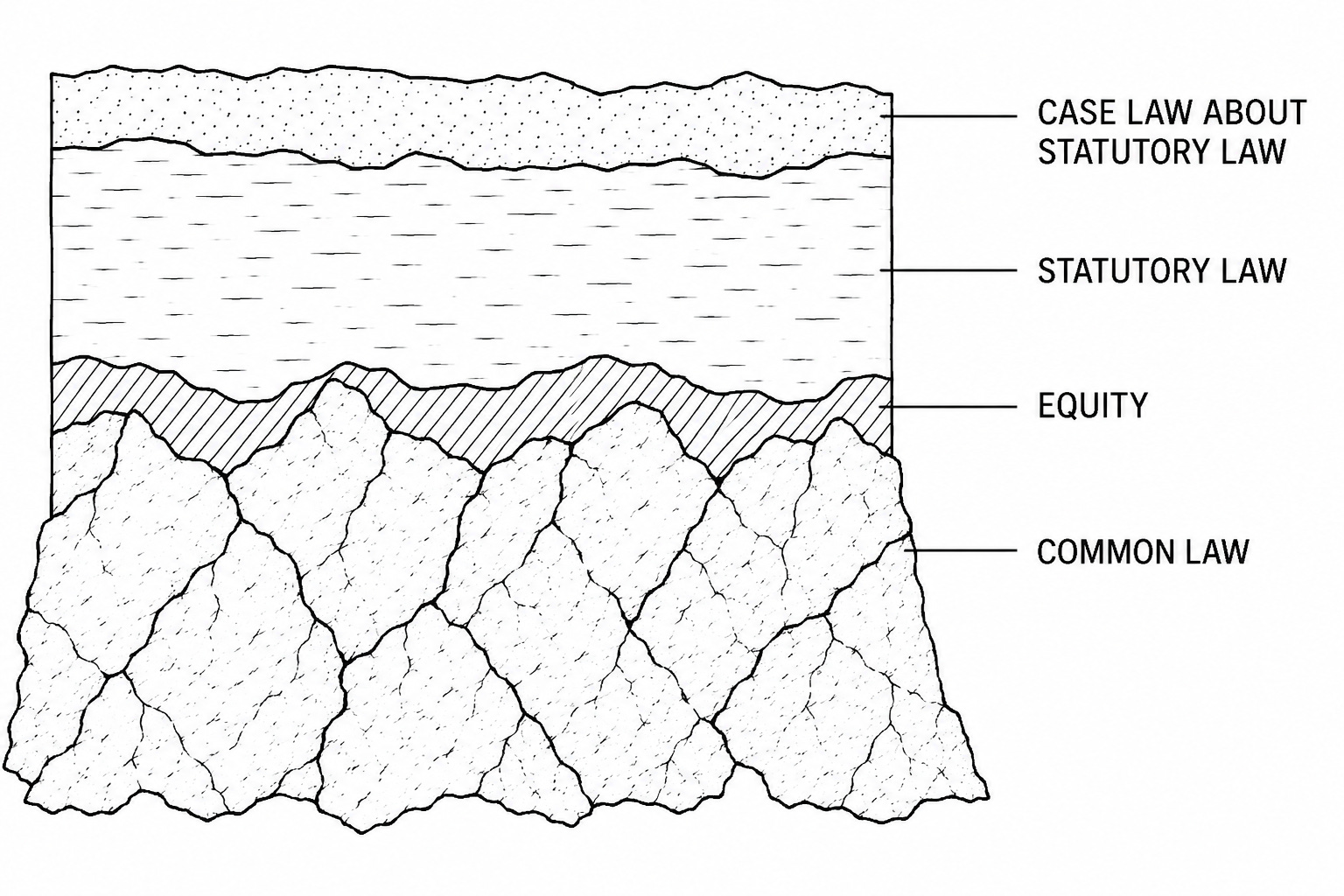
To understand this properly, you first need to get your head around the layers of substrate that make up the New Zealand legal system, of which there are broadly three.
The bottom layer is the common law. This is the oldest part of the system and also the least intuitive for modern people to wrap their heads around. It is not contained in a single written code, but consists of principles developed by judges going back to the aftermath of the Norman invasion.
It developed through judges deciding actual disputes, with each decision building on earlier precedent. The answer to what the common law says in any given situation is often drawn from a vast body of judgments, binding and persuasive, from New Zealand and across the wider common law world.
We then have a layer on top of the common law which is known as the law of equity. This is another set of unwritten laws that allows people to seek relief when the common law produces unfair results. The common law and equity were once administered through different processes but are now administered together by the same courts. It’s worth noting the distinction but for simplicity I am just going to bundle equity in with the common law for the purposes of this column.
The next layer is legislation made by the Crown in Parliament, which is superior to the common law. Parliament can preserve the common law, amend it, abolish it or replace it altogether. This is not because statutes are wiser than judge-made law, but because they carry democratic authority. In our constitutional system, when statute and common law conflict, statute wins.
The top layer is case law about statute law. Once Parliament legislates, courts must interpret what the legislation means, how its provisions fit together and how it applies to particular disputes. This is an entirely legitimate judicial function, but it is different from ordinary common law development because the courts are interpreting Parliament’s commands rather than building legal principles from the ground up.
Smith’s case sits at that bottom layer. He is not primarily arguing about what the Climate Change Response Act 2002 means or how Parliament’s statutory scheme operates. Instead, he is asking the courts to develop the common law itself by recognising a new tort imposing liability for contribution to climate change.1
Abandoning an important fiction
There was a longstanding legal fiction that courts merely “discover” the common law rather than create it. The idea is that the law already exists in latent form within precedent and principle, and judges simply uncover and apply it to new situations. That fiction has increasingly been abandoned by legal academics. Few serious legal theorists now believe that judges simply find the common law sitting there like buried treasure.
And it needs to be said that there is nothing inherently improper about courts recognising new torts. The law of negligence itself was once new. Before the nineteenth century, many of the duties and liabilities we now take for granted simply did not exist in recognisable form. Of course, negligence was not invented in one dramatic judicial flourish to resolve a major political controversy already being actively regulated by legislation.
In any event, the fiction that judges "discovered” the law was useful because it fostered a sense of restraint. It forced judges to reason with precedent, analogy and continuity with earlier decisions in mind. That, in turn, encouraged humility, caution and the understanding that courts are not free to redesign society according to contemporary fashion. Once judges openly conceive of themselves as lawmakers, even in a limited sense, the temptation grows to treat difficult political questions as opportunities for judicial innovation.
Over time, the mindset subtly shifted from “I cannot see precedent for why the law should recognise this” to “I cannot see why the law should not recognise this.” That sounds like a small change in phrasing, but constitutionally it is enormous.
This was reflected in the Smith judgment. The Court did address the settled doctrinal objections to the claim, such as the absence of a sufficiently proximate relationship between particular emitters and alleged harm, the indeterminate scope of liability, the diffuse and collective nature of global emissions, and the traditional requirement for special damage distinct from that suffered by the public generally.
But rather than treating those doctrines as the bulwarks they have long been understood to be, the Court signaled a willingness to revisit them for the right causes. The special damage rule, for instance (a rule of standing that has been part of New Zealand law since 1869) was said to “require reconsideration in a 21st century context.”
That is, in effect, a charter for dismantling any doctrinal limit a future court finds inconvenient, provided the harm in issue is contemporary enough to warrant 'reconsideration.
Parliament’s whack-a-mole response
Parliament has responded with a targeted solution by legislating to stop claims like Smith’s from proceeding. But, of course, this will only invite further trouble because only one particular instance of a symptom is being addressed. Each time courts push the boundaries of common law development into politically contentious territory, Parliament must return with another bespoke statutory correction.
And, actually, that is neither efficient nor healthy for the long-term balance between democratic law-making and judicial adjudication.
Parliament needs to become more assertive in defending its constitutional authority as a general principle rather than merely reacting to individual cases as they arise. Part of that should involve restoring some of the older assumptions that once guided common law development. That’s not to abolish the common law or prevent its gradual evolution, of course, but to the older understanding that the common law develops best when institutional humility is seen to be a core institutional value.
A carefully drafted amendment to the Constitution Act 1986 could instead establish a small set of constitutional principles to guide the future development of the common law. The judicial branch would be redirected to prioritising development that maximises legal certainty, predictability and continuity so that citizens can reasonably order their affairs in advance. There will still be developments in the law, but people could be confident about what the edges are.
The section could look like this:
24A Development of the common law and equity
In developing the common law and rules of equity, the courts must—
(a) have principal regard to the importance of legal certainty, predictability and continuity:
(b) proceed by reference to established legal principles: and
(c) refrain from influencing or commenting on contested political or social questions except to the extent necessary to resolve the matter before them.
Blowback to be anticipated
Quite a bit of bravery would be needed here because the reaction from sections of the legal establishment would be immediate and hostile. It would be described as an attack on judicial independence, an assault on the rule of law and an attempt by Parliament to politicise the courts. It would also be an objection based upon a convenient asymmetry.
When courts steadily expand their own role through increasingly adventurous common law development, Parliament must have the tools to respond. It is not inconsistent with the rule of law for the democratic legislature to say, at some point, that the common law exists to provide stable and predictable legal ordering.
In Smith, there was a consistent emphasis throughout that Parliament had not expressly foreclosed this particular common law development. That was treated more or less openly as a reason to contemplate the reworking of long-settled limits on tortious liability. Parliament is entitled to make the courts aware that its silence on a particular question is not a standing invitation to legislate from the bench.
This would be a better and more transparent way to ensure that than drifting towards a system where the political philosophy of judicial appointments becomes one of the most important determinants of public policy. Which is where this all leads otherwise.
Supreme Court justices would strenuously deny that their ruling in Smith had anything to do with politics at all. And one thing we can all be sure about is that they are all extremely clever people acting in utmost good faith to apply their very sharp and honed minds to the situation as they see it.
But the legal profession does not get to unilaterally decide what is political and what’s not. That’s for the people who are subject to the politics to decide. And any perception that the courts are willing to sally forth into social and political controversy will invite a response.
And when the people who actually hold democratic legitimacy conclude that the courts themselves have become a political battlefield, no amount of handwringing will prevent appointments from becoming openly ideological contests.
Once courts are seen as policymakers, society will start treating them accordingly. It doesn’t matter if it’s fair. It’s what will happen.
A tort is a civil wrong recognised by law, other than breach of contract, for which a person may sue for compensation or other remedies. Common examples include negligence, nuisance, trespass and defamation.
A fair argument, as far as it goes. Would be good to see how you see the NZ Bill of Rights meshes with the government's pre-emption of the case in question and how it fits with ideas of natural justice. Would also be good to have your view on the avoidance of select committee oversight of the law change. I thought Magna Carta sorted out the vexed issues of the rule of law, due process and access to justice.
It seems to me that the government's action in the matter displays a level of autocratic regal entitlement that contradicts the idea of democratic law making.
Law by fiat seem to be the antithesis of democracy, surely?
Hmmm. Is it fair to characterise the case in terms of "a newly invented tort", "a novel tort untethered from established precedent" and "a new tort" when the core plank in the Supremes was about the application of the long established tort of public nuisance? Sure, his third cause of action was a novel tort (and his second cause of action was in negligence). But it was the claim in public nuisance was core argument that survived strike out?