
The reason conservatives *hate* the Spinoff
(Because we wish we had one)

A lot of my readers really, really hate The Spinoff. In part, that’s because it has been such an effective media operation for so many years and it reflects a left leaning sensibility and demographic. Because of its effectiveness, I’ve been approached a number of times about what it would take to get a right wing version going.
The thing is, The Spinoff gained its initial reputation not by shouting its political preferences from the rooftops, but by producing work of quality and depth. Its left-leaning nature was incidental to its content, not the driving force behind it.1
This “obliquity” is why imitators are doomed to fail. It is hard to make ideological content that happens to be good. It is easier to make good content that happens to be ideological. But when you set out to create political content, you inevitably choose the more challenging path.
Unlike so many of my readers, I do not hate The Spinoff. You are what you read. If you are not willing to expose yourself to opposing arguments the thing you will be is out of touch with the reality of political opinion as it exists across the spectrum.
More than any of its competitors, The Spinoff provides an articulate - and often quite brio - expression of the progressive worldview.
Which means that I do not take much satisfaction in learning the publication finds itself - like most media - with some measure of financial strain. A stagnant advertising market and a decline in public funding have taken a toll with the result being an open letter to its readership with an urgent plea for support.
I hope they can make up enough of the difference to avoid further layoffs.
One thing we need to discuss is what media we fund with public resources. According to the letter, The Spinoff could once count upon quite consistent state funding through the likes of NZ on Air. It has this year found itself rebuffed by the agency.
State support for media is a delicate matter. A healthy society requires a diversity of voices, and public funding can, when prudently managed, help achieve this goal. However, public funds should probably only be directed towards journalism that serves the fundamental purpose of informing the public without bias or comment, essentially, the more mundane but essential forms of journalism that focus on factual reporting and not the propagation of virtue and the prevention of vice.
Consider, for example, The Side Eye, a cartoon series published by The Spinoff with support from NZ on Air to the tunes of tens of thousands of dollars a year until 2023.
The series had a lively aesthetic and often addressed things in the news. It did so, however, as what amounted to state-funded political advocacy. The series advocated for the orthodox liberal view of things with an unwavering predictability that left no room for counterargument or genuine dialogue.
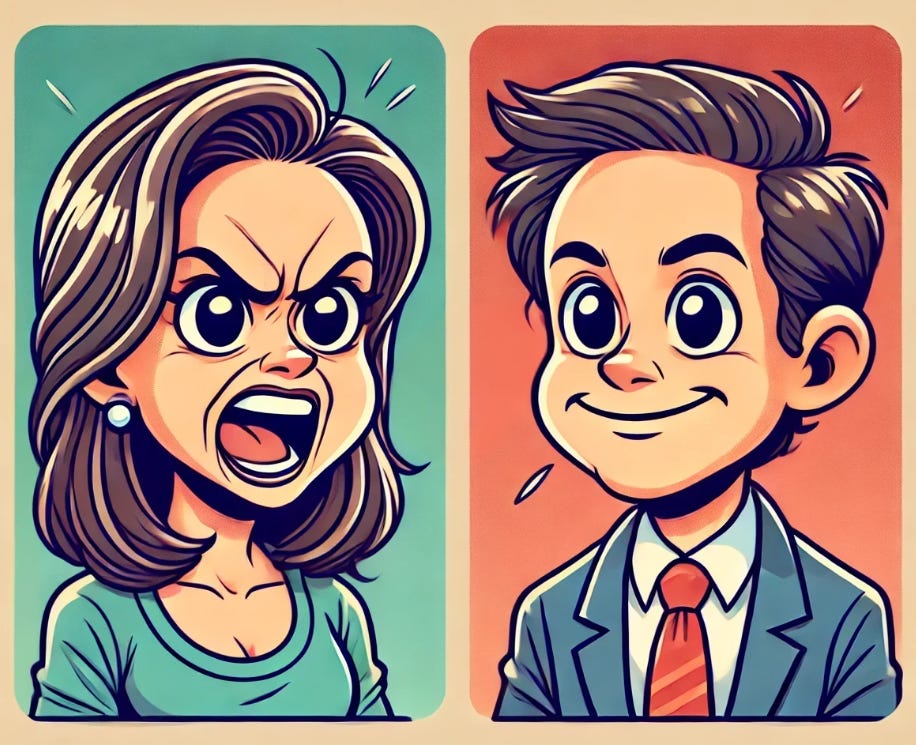
This is particularly evident in the way characters were visually represented. Liberals and progressives are drawn as diverse, warm and relatable. Their clothing was colourful, their body language open, and their facial expressions radiated concern, empathy or quiet determination. They are shown as part of a community, working together toward shared goals, whether that’s holding protest signs or tending gardens.
Conservatives and libertarians, on the other hand, were objects of disdain. Their clothing is plain and muted, signalling a lack of individuality or warmth. Their body language is closed off: crossed arms, clenched fists, or an air of defensiveness. Their faces often feature exaggerated scowls, furrowed brows, or other expressions of anger and resistance. And, of course, they were almost always drawn as Pākehā.
Even the settings reflect these biases. When progressives are depicted, they were often in open, lush, natural spaces, symbolising freedom and growth. Conservatives, meanwhile, appeared in starker, more confined spaces, reflecting rigidity and opposition to change.
The artistic shorthand removed any obligation to grapple with the substance of opposing viewpoints. Conservatives and libertarians are not just portrayed as wrong but as inherently flawed, their arguments undermined by the way they are drawn. The simplicity of this approach might make the messaging more accessible, but it’s not really clear why taxpayers should have been on the hook for what amounted to a liberal church sermon.
And that’s what it often sounds like, frankly. This in turn, brings to mind the statement of Thomas Jefferson that “To compel a man to furnish contributions of money for the propagation of opinions which he disbelieves is sinful and tyrannical.”
Just to be clear, it is not my intention to pick on a single series! One of the reasons this particular cartoon series was so frustrating to me as a conservative was that it was, first and foremost, done well. It demonstrated genuine artistry, with a knack for visually representing an argument in a way that was both clever and compelling.
If you find yourself unable to appreciate good craftmanship just because it takes against your position, it might be time to lighten up.
And, just for the avoidance of doubt, I have never objected to this kind of content having a strong influence on the discursive environment. Advocacy content has every right to exist and to articulate its perspective without dilution.
But content of that nature belongs in the marketplace of ideas, supported by private subscriptions, sponsorships or advertising. I am not convinced it warrants public funding. While I am not glad to see anyone lose an income, I would also be relieved to learn that public funds are no longer being so freely used to support what is essentially political advocacy.
If you’re a liberal, you should absolutely take up a membership at The Spinoff. It remains an articulate, creative and interesting place for progressive thought (and snark) in New Zealand media. If you value its work, you should support it.
(But—only after you’ve paid for The Blue Review)
Disclosure: For a time I contributed to The Spinoff, offering the occasional contrarian reflection. I enjoyed doing so because they paid on time, the audience was sophisticated, and I think I wrote some of my best columns there. Those invitations ceased some years ago, for reasons unknown to me. Either my work degraded, new commentators were preferred, or the publication had just moved on.
Thanks for the observations Liam.
What I find amusing about the Spinoff is the bleat that they did not get funds from Creative NZ or NZ On Air. Good grief. Do media outlets have to have handouts to survive.
We saw the debacle that was the Public Interest Journalism Fund. Then there is another subsidy with the Fair Digital News Bargaining Bill but that is shelved for the timke being. And now this.
Good on them for going to their readership. Maybe there will be a few more paying customers and the Spinoff will develop a market sense rather than rely on handouts. If does rely on handouts for its survival then it should fail. Should that sound like economic Darwinism - well it is an I am not apologetic for it. As to its position on the spectrum - it is a good thing to have a variety of viewpoints. But once again, they have to be able to survive in the jungle.
As to the tone of the Spinoff - a bit righteous - and I could dop without Madeleine Chapman's preaching.
The reason we hate them is not for the reasons you suggest. We hate them because they are propagandists and even more so after they've availed themselves of millions of dollars from the PIJF and other sources. They don't have a viable business model, they've built the business on grants, subsidies and a little bit of grift. Now the grants and subsidies are gone, so too will they follow.
They are corporate bludgers. Take away state largess and they are hollowed out.