

Three weeks later...
The media told Luxon to embrace his inner Jacinda Ardern. How does that look three weeks later?

As the country heads into the last week of April, it is now three weeks since the Prime Minister agreed, in a moment of commendable openness, to disregard the advice of his own officials and advisors and instead follow the strategic guidance of the metropolitan news media.
The guidance from reporters and journalists was simple enough. Be visible, be empathetic, seize the moment, do something and - above all - do everything you can to “look like Jacinda Ardern” in a crisis. Internal critics called it a bold move, arguing that there is no particular reason to think that media outlets have either National’s best interests at heart or much insight into the mood of the public. Throwing caution into the wind, however, Luxon has embraced the advice.
The opening move was naval. Acting on the theory that decisive leadership requires decisive gestures, both New Zealand frigates were dispatched to the Strait of Hormuz to force its reopening. Government supporters hailed the order as bold and values-driven.
Officials have since confirmed that while the ships are no longer afloat, they did succeed in projecting resolve, which was widely regarded as the point. Defence minister Judith Collins has hailed the contributions of the Te Kaha and Te Mana as the most stirring episode in New Zealand naval history since the valiant heroics of the HMNZS Manawanui in the battle of Upolu Island in 2019.
With the government announcing it does not intend to replace the frigates, Luxon pivoted to diplomacy. His ferocious denunciation of the United States at the United Nations was described by journalists at home and abroad as courageous, principled and morally serious. Overseas analysts have noted it is the strongest critique of the escalation of the United States by a friendly nation since the conflict began.
The move was not cost-free, however, with the Trump administration imposing an additional 35% tariff on all New Zealand exports as a result. While acknowledging that this has been an unwelcome addition to economic headwinds, the Beehive has been quick to point to several editorials in local publications giving the government begrudging praise for its willingness to criticise Donald Trump. Exporters have been encouraged to reflect on the intangible benefits of having their government speak with clarity.
At home, the Prime Minister leaned into the human dimension of leadership. A nationwide tour saw both Luxon and his deputy Nicola Willis offering cuddles to truck drivers and petrol station owners in a bid to steady nerves and demonstrate solidarity. It is fair to say that uptake has been mixed, and petrol station owners have objected to the timing of these encounters, which tend to coincide with empty forecourts.
Both groups are now organising a mass protest to take place at Parliament next month, which officials say shows the policy has “cut through”. Asked about the likely gridlock in the capital, the Prime Minister downplayed the scale of the event, noting he was “struggling to see how they’d get there”.
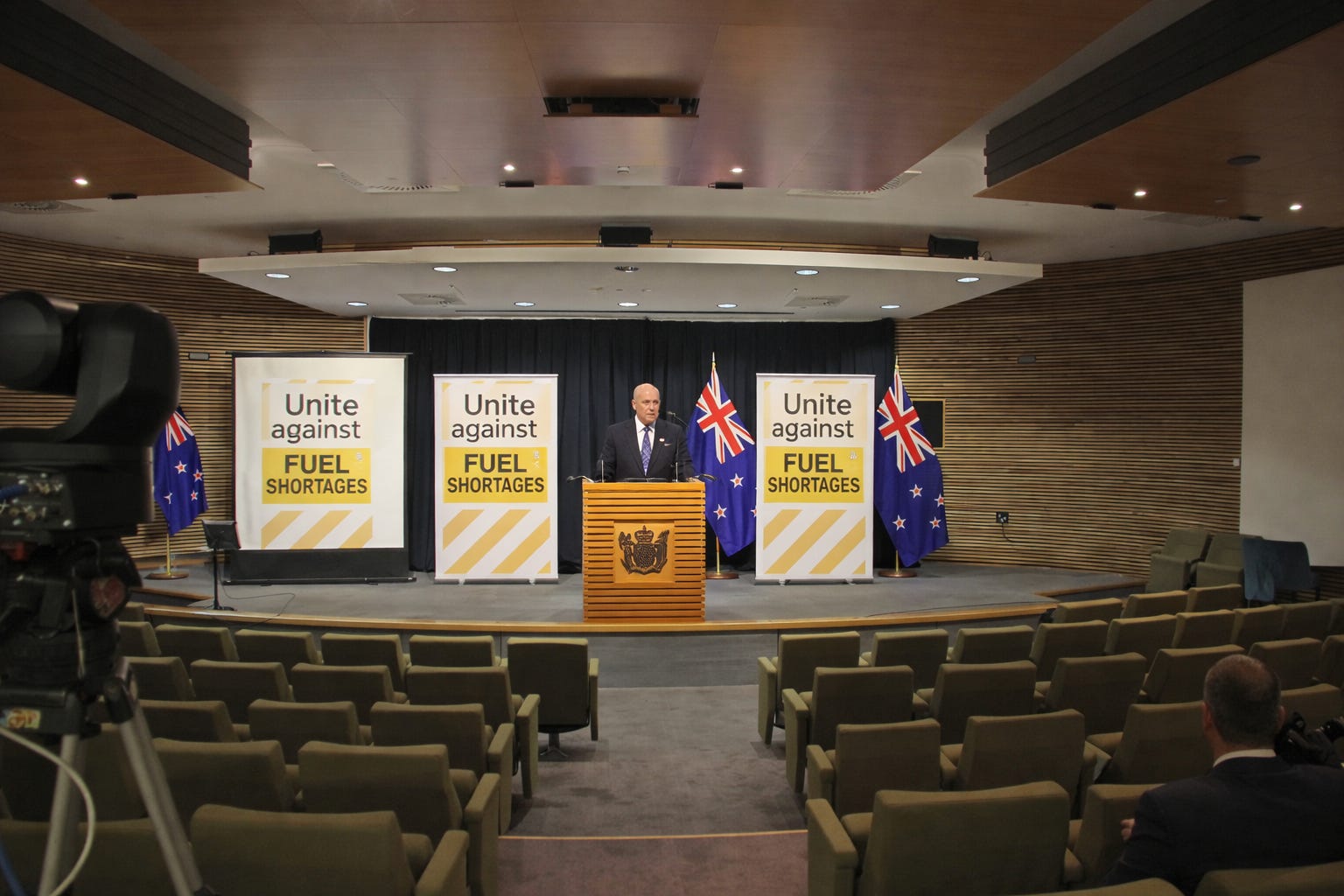
The communications piece, so central to the original critique, has also been delivered in full. The mothballed podium of truth having been dusted off, the daily 1pm press conference now proceeds with ritual precision. Each day, the Prime Minister announces the diesel reserves, often to a decimal point. The audience, however, has proved less reliable, with viewership tapering off somewhere between “6.9 days remaining” and “6.8 days remaining”.
Still, it would be unfair to say the government’s recalibrated response has no supporters. The nationwide lockdown, introduced to conserve fuel and signal unity, has been warmly received among public servants and teachers, who have embraced the return to remote work with professional enthusiasm. The Public Interest Journalism Fund 2.0 was also welcomed, particularly by those receiving it, as a timely investment in democratic storytelling.
Even here there is a limit to comfort for the government, however. A new poll indicates that journalists, teachers and public servants, despite their approval of the new government’s approach, continue to favour Labour, the Greens and Te Pāti Māori at the forthcoming election.
There has been at least one unexpected dividend. Officials confirmed this week that New Zealand is now on track to meet its 2030 climate change emissions targets for the first time. The achievement has not, however, satisfied the Greens, who have called on the government to restore the offshore drilling ban introduced under Labour and New Zealand First in 2018, describing the current fuel shortage as no excuse for complacency.
You nearly had me there as I wondered initially if I had been asleep for a while.
Writing like that is hard to pull off but you did it.
Well done
And 3 weeks hence? Doom and gloom and empty supermarket shelves or cheers and US flags waving as POTUS lands AirForce1 in Tehran and Luxon and Peters squabble about who should go and pledge NZ support